
Polymarket switched to TWAP60 pricing for its 15-minute and four-hour crypto up-or-down markets on August 7, 2026, replacing single-timestamp settlement with a Chainlink-computed average. The five-minute markets also moved to TWAP pricing, but they use a shorter 30-second window.
That distinction matters. Polymarket did not move every market to one universal TWAP60 feed. The change applies to short-duration crypto markets, with the averaging window matched to the market format: TWAP30 for five-minute contracts and TWAP60 for 15-minute and four-hour contracts.
For traders, the result is a different final-minute game. A one-second price wick carries less weight than before. For bot builders, the settlement reference must now be tracked as a time-weighted value rather than inferred from a spot exchange or the last visible print.
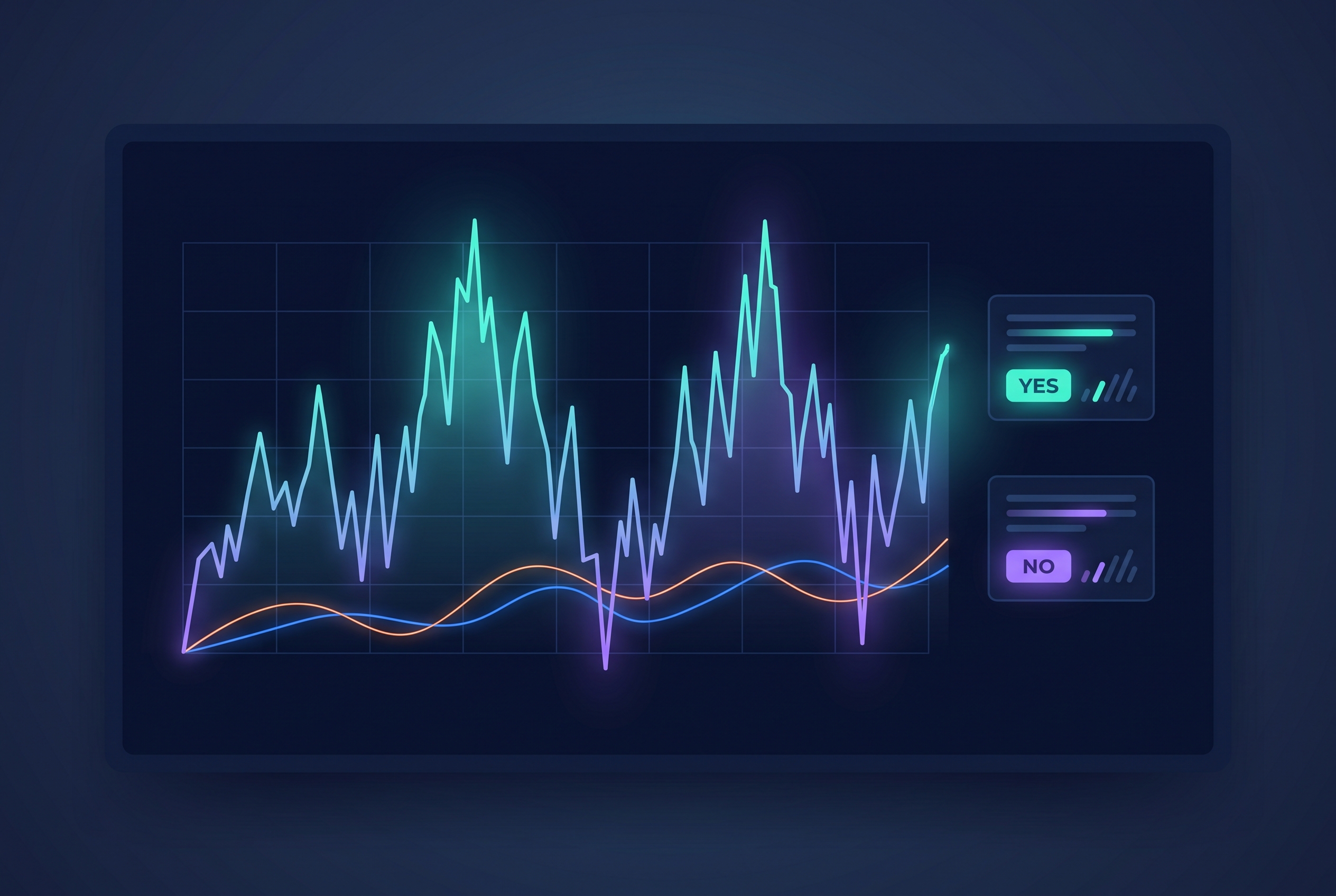
What changed when Polymarket switched to TWAP60?
Before the change, short-duration crypto markets could be resolved using a price observed at a specific boundary. A snapshot is simple, but it gives unusual importance to the final seconds. If the underlying asset briefly crosses the market threshold at exactly the relevant timestamp, that print can decide the contract even when the move immediately reverses.
Under the new system, Chainlink Data Streams computes a time-weighted average across a defined lookback window. Polymarket then uses that averaged reference for the affected crypto markets.
The transition took effect on August 7, 2026, according to coverage from Genfinity. The report says five-minute markets use a 30-second average, while 15-minute and four-hour up-or-down markets use a 60-second average. Both the opening reference and final settlement reference use the applicable TWAP feed.
The official Polymarket Chainlink TWAP documentation confirms that Chainlink-computed 30-second and 60-second feeds are live and available through both Chainlink Data Streams and Polymarket RTDS.
What TWAP60 actually means
TWAP stands for time-weighted average price. TWAP60 represents an asset price across the preceding 60-second lookback window. Every part of that minute contributes to the result, so a brief spike influences the average without automatically becoming the final value.
Imagine Bitcoin trades near $65,000 for most of a minute, jumps to $65,200 for two seconds, and then returns. A single snapshot taken during that jump could report $65,200. TWAP60 would remain much closer to the price that dominated the whole minute.
This does not make TWAP60 slow or irrelevant. A sustained move still pulls the average higher or lower. The key difference is that duration now matters alongside price.
Another important detail from the official documentation is that 60 seconds describes the lookback window, not the update frequency. Developers must read the observation timestamp carried by the feed rather than guessing freshness from how often messages arrive.
Which Polymarket markets use TWAP30 and TWAP60?
| Polymarket crypto market | Reference window | Practical effect |
|---|---|---|
| 5-minute up or down | TWAP30 | Faster response with some protection from very short spikes |
| 15-minute up or down | TWAP60 | Full-minute averaging gives sustained moves more influence |
| 4-hour up or down | TWAP60 | The same 60-second settlement window is used at the boundary |
Traders should still read the exact resolution rules on every market. A market title, duration, or historical pattern is not a substitute for the declared source and window.
Why Polymarket moved away from snapshot pricing
The core design problem is straightforward: a single-timestamp reference concentrates settlement risk into one moment. Anyone able to influence the underlying exchange price near that moment may affect the contract outcome.
BSC News reported that the change followed research flagging suspicious final-second activity in five-minute Bitcoin markets. Polymarket disputed the claim that manipulation occurred, but the move to averaged settlement directly reduces the influence of isolated last-second prints.
TWAP changes the economics of any attempted price push. Moving a market for one second is not enough to control a 30-second or 60-second average. Pressure must be sustained across more of the window, which generally requires more capital and gives other market participants more time to trade against the distortion.
That is an improvement, not a guarantee. A sufficiently large and sustained move can still affect the average. The new method raises the difficulty of exploiting a boundary; it does not make settlement immune to market structure.
What Polymarket TWAP60 changes for traders
The last visible spot price is no longer enough
A trader watching only Binance, Coinbase, or another exchange may see a price that differs from the Chainlink average. The relevant question is not simply where Bitcoin trades now, but where the applicable TWAP sits relative to the market threshold.
Short wicks matter less
A brief move across the threshold can still influence TWAP60, but its weight depends on how long it persists. This reduces the value of strategies built around one final print.
The Polymarket order book remains separate
TWAP60 tracks the underlying crypto asset. YES and NO prices on Polymarket reflect implied probability, liquidity, spread, and trader demand. A gap between the order book and the reference feed is not automatically an arbitrage. Execution costs, timing, and resolution language still matter.
Entry timing becomes more path-dependent
Two spot prices can be identical while the corresponding TWAP60 values differ because the preceding minute followed a different path. Traders need the recent sequence, not only the latest number.
What bot builders need to change
A Polymarket bot should subscribe to the official feed rather than approximate TWAP60 independently from a random exchange. Polymarket RTDS relays Chainlink-computed updates without requiring Chainlink credentials. Direct Chainlink Data Streams access is available when a backend needs the original signed report or a latest report before streaming.
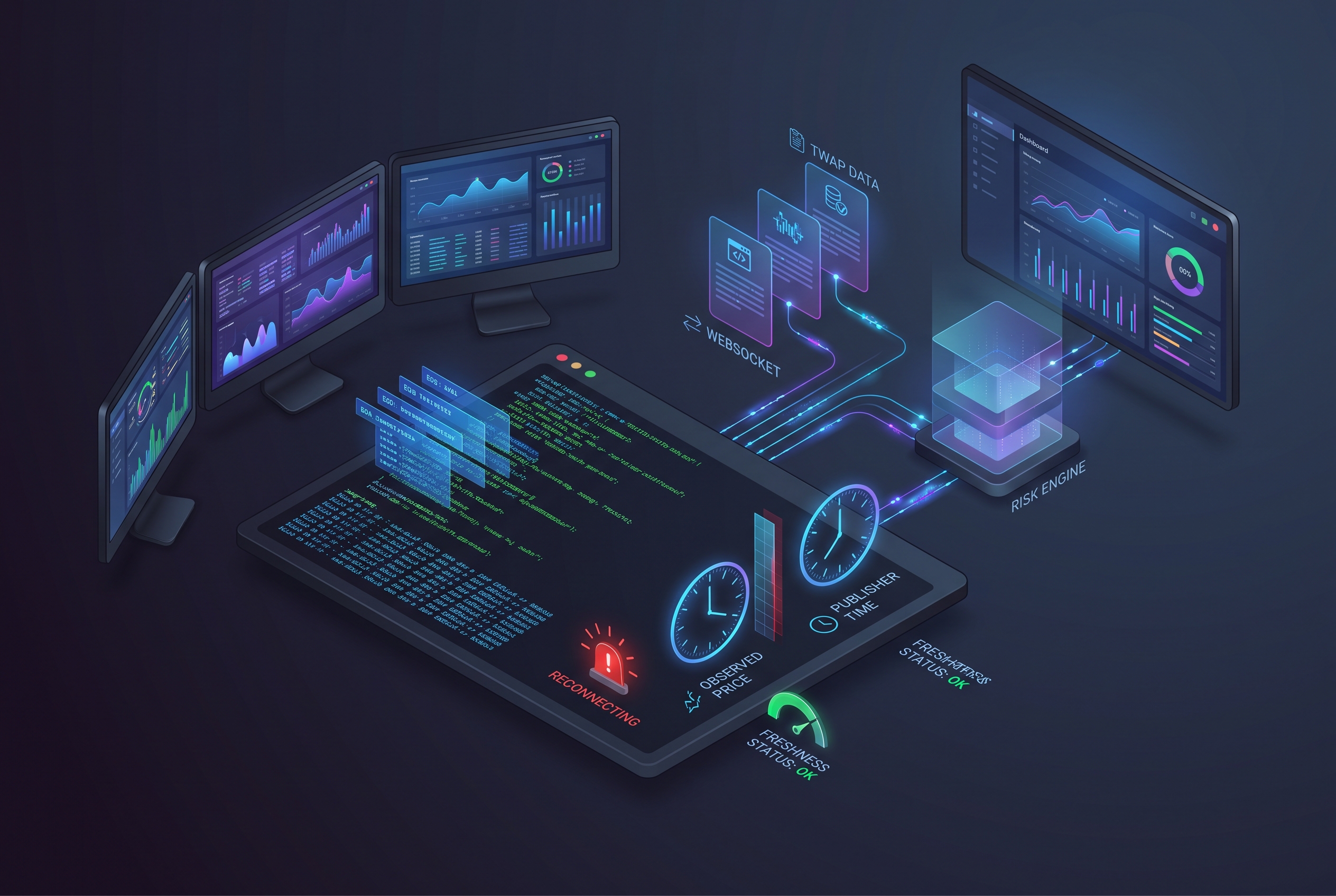
A production integration should record
- The lowercase symbol, such as btc/usd
- The selected 30-second or 60-second window
- The exact decimal value
- The Chainlink observation timestamp
- The RTDS publication timestamp
- The market and outcome token IDs
- The order-book snapshot used for execution
- The accepted, resized, or rejected decision reason
The official feed returns exact decimal data. Converting it carelessly to floating-point values can create rounding errors near a threshold. Bots should preserve decimal or fixed-point precision through the entire decision path.
Disconnect behavior also matters. RTDS starts with the next update and offers no snapshot, history, or replay after a disconnect. Until a fresh event arrives, a safe bot should block new decisions rather than reuse stale TWAP60 data.
The broader architecture in How to Build a Polymarket Trading Bot still applies: strategy, risk, execution, order state, and reconciliation must remain separate. The guide to Bitcoin 5-minute and 15-minute bot strategies provides additional context for short-duration markets.
What TWAP60 does not solve
TWAP60 reduces sensitivity to a fleeting price spike, but it cannot eliminate every settlement risk. A sustained underlying move still changes the average. A delayed feed can still make a bot unsafe. Incorrect symbol mapping can still produce the wrong decision. Thin Polymarket liquidity can still turn a correct signal into a poor fill.
Chainlink also does not publish every custom detail of sampling boundaries, weighting, rounding, or missing-input behavior. Developers should consume the official value rather than claiming to reproduce it exactly from unrelated market data.
The strongest interpretation of the switch is therefore practical, not promotional: Polymarket replaced a fragile single-moment reference with a more robust time-window reference for short-duration crypto markets.
Bottom line
Polymarket switched to TWAP-based settlement on August 7, 2026. Five-minute crypto markets use TWAP30. Fifteen-minute and four-hour crypto markets use TWAP60. The change makes isolated last-second price spikes less decisive and forces traders to follow the entire settlement window.
For manual traders, that means watching the correct reference rather than the final spot tick. For bots, it means integrating the official feed, checking timestamps, preserving exact decimals, and failing closed whenever the data state is uncertain.
Test the new TWAP60 logic in paper mode before using live capital, and audit every difference between the reference feed, the Polymarket order book, and the final fill.