
Building a Polymarket trading bot is not mainly an order-submission problem. The difficult part is keeping market data current, measuring an edge against executable prices, preventing duplicate or oversized orders, and reconciling every fill.
This guide walks through a practical architecture for a Polymarket trading bot in 2026. It covers market discovery, real-time order books, strategy logic, order execution, risk controls, paper testing, and production monitoring. It does not promise profit. A bot automates a process; it cannot create an edge that is not there.
What a Polymarket trading bot actually does
A complete bot repeats a controlled loop:
- discover a market and its outcome token IDs;
- subscribe to fresh bids, asks, trades, and market-state updates;
- calculate a strategy signal;
- check price, liquidity, exposure, balance, and system health;
- create and submit an order;
- track the order through fill and settlement states;
- reconcile the resulting position;
- record every decision for later review.
The official Polymarket trading quickstart shows the core authenticated order flow. A production bot adds several layers around that flow so one stale signal or unexpected partial fill does not become an uncontrolled position.
The seven components of a production bot
| Component | Job | Failure to prevent |
|---|---|---|
| Market discovery | Finds events, markets, outcomes, and token IDs | Trading the wrong outcome or closed market |
| Market-data service | Maintains live bids, asks, trades, and timestamps | Acting on stale prices |
| Strategy engine | Turns data into a priced signal | Trading without a measurable edge |
| Risk engine | Applies size, exposure, loss, and latency limits | Oversized or concentrated positions |
| Execution engine | Creates, submits, updates, and cancels orders | Duplicate and uncontrolled orders |
| Reconciliation | Compares expected orders with actual balances | Hidden position drift |
| Monitoring | Alerts on data, order, balance, and service failures | Silent production errors |
Step 1: define the strategy before writing the bot
A strategy needs a falsifiable rule. Fast code without a priced hypothesis only loses money faster. Write down the signal, entry condition, exit condition, expected holding time, required liquidity, and maximum acceptable loss.
Common strategy families include:
- Market making: quote both sides and attempt to earn spread while controlling inventory.
- Arbitrage: trade logically inconsistent executable prices across outcomes or related markets.
- Information reaction: update fair probability when a trusted source releases new evidence.
- Wallet tracking: treat selected public wallet trades as signals under independent follower limits.
- Relative value: compare related probability curves and trade the difference.
Our guide to how Polymarket bots make money explains the risks behind each approach. Choose one narrow strategy for the first version. Mixing several unfinished ideas makes debugging almost impossible.
Step 2: discover markets and outcome token IDs
A bot should not hardcode a market title and assume it never changes. Store stable identifiers, market status, outcomes, token IDs, resolution details, minimum order size, tick size, fee parameters, and whether order-book trading is enabled.
Before every new order, verify that the market is active, the intended outcome token is correct, and the strategy still applies to the exact resolution language.
market = discover_by_slug(target_slug)
assert market.active
assert market.order_book_enabled
outcome = select_outcome(market, desired_side)
token_id = outcome.token_id
This pseudocode is intentionally simple. The important design choice is validation before execution, not the programming language.
Step 3: maintain a real-time order book
Displayed market prices are not enough for execution. A buyer pays available asks and a seller receives available bids. Your bot needs the price and quantity available for its intended size.
The official real-time market-data documentation describes streams for order-book changes, price changes, last-trade prices, and market lifecycle updates. Use timestamps on every update and reject stale data.
For each token, maintain:
- best bid and best ask;
- full depth or enough levels for your maximum size;
- spread;
- last trade price and time;
- market status;
- last successful stream timestamp;
- sequence or snapshot consistency where available.
If the stream disconnects or falls behind, the bot should stop new orders until it rebuilds a valid state.
Step 4: calculate executable price, not screen price
Suppose the best ask is $0.42 for 100 shares, the next level is $0.44 for 200, and the next is $0.47 for 500. A 500-share buy cannot be modeled at $0.42. The expected average is based on all consumed levels.
Use depth-weighted price:
Average execution price = total cost across consumed levels ÷ filled shares
| Ask level | Available shares | Shares consumed | Cost |
|---|---|---|---|
| $0.42 | 100 | 100 | $42 |
| $0.44 | 200 | 200 | $88 |
| $0.47 | 500 | 200 | $94 |
| Total | 500 | $224 |
The modeled average is $0.448 before other costs. A signal based on $0.42 would overstate its edge.
Step 5: build the strategy engine
The strategy engine should output more than buy or sell. It should produce a structured proposal that can be audited:
proposal = {
  market_id,
  token_id,
  side,
  model_price,
  maximum_order_price,
  requested_size,
  expected_edge,
  signal_timestamp,
  strategy_version,
  reason
}
The risk engine can then accept, resize, or reject the proposal. Keeping signal generation separate from execution prevents strategy code from bypassing portfolio limits.
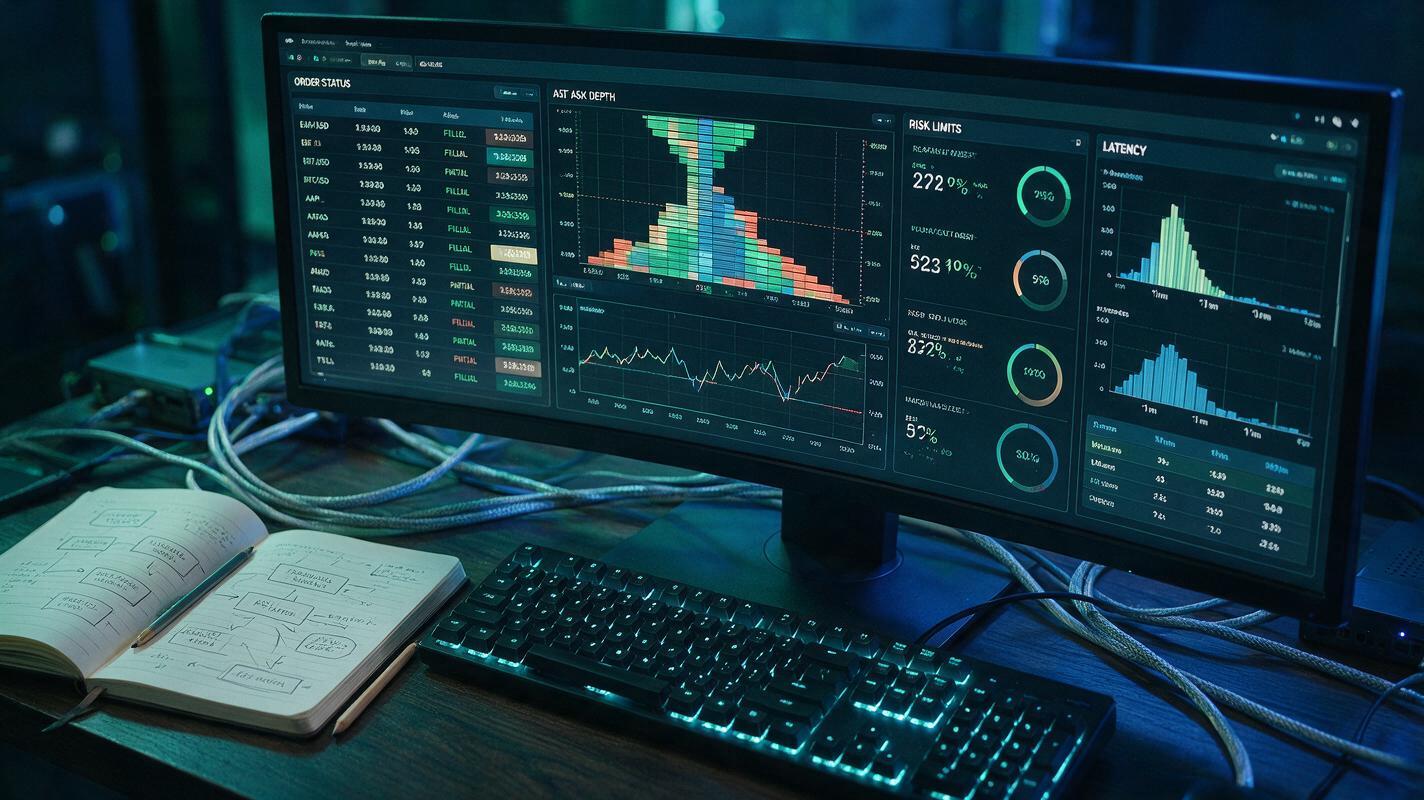
Step 6: put risk controls in a separate gate
Every proposed order should pass the same controls regardless of strategy:
| Control | Example question |
|---|---|
| Data freshness | Is the order book newer than the maximum allowed age? |
| Price bound | Can the order fill without crossing the worst acceptable price? |
| Liquidity | Is enough depth available for the requested size? |
| Market exposure | Would the new position exceed the market cap? |
| Category exposure | Is the portfolio already concentrated in this topic? |
| Daily loss | Has the strategy or account hit its stop? |
| Balance | Is sufficient spendable balance available after open orders? |
| Duplicate protection | Has an equivalent signal already created an order? |
| System health | Are data, execution, database, and alerts healthy? |
Risk controls should fail closed. When status is uncertain, reject new activity and alert an operator.
Step 7: choose order behavior deliberately
Order behavior changes strategy results. An immediate order may fill quickly but pay spread and slippage. A resting limit order controls price but may never execute.
The official order lifecycle guide describes Good Till Cancelled, Good Till Date, Fill Or Kill, Fill And Kill, and post-only behavior.
| Order behavior | Useful when | Main trade-off |
|---|---|---|
| GTC | You can wait for a limit price | Open order can become stale |
| GTD | The signal has a clear expiration | May expire without filling |
| FOK | Partial size would break the strategy | Entire order may be canceled |
| FAK | Partial execution is acceptable | Position may be smaller than planned |
| Post only | You want to add liquidity | Rejected if it would immediately match |
Step 8: treat order submission as a state machine
Submitting an order is not the end. Store a client-generated idempotency key before sending it, then track every response and transition.
signal_created
risk_approved
order_submitting
order_live | order_matched | order_partial | order_rejected
trade_confirming
position_reconciled
closed
Retries must reuse the same intent rather than create a new order. After any timeout, query the authoritative order state before deciding to submit again.
Step 9: reconcile positions and balances
Your database is an expectation, not the final truth. Periodically compare open orders, filled amounts, positions, and spendable balance with authoritative account data.
Reconciliation should detect:
- an order marked live locally but already filled;
- a partial fill recorded as complete;
- a duplicate order;
- a position without a known originating order;
- balance reserved by forgotten open orders;
- a settlement or redemption not reflected locally.
Pause trading when unexplained differences exceed a small threshold.
Step 10: secure signing and credentials
Never place raw private keys in source code, logs, chat messages, or analytics tools. Use a dedicated signing boundary, least-privilege access, encrypted secret storage, and separate development and production identities.
Log intent, order IDs, prices, sizes, timestamps, and results—but never credentials or sensitive signing material. Add manual revocation and a kill switch before live deployment.
Step 11: paper-test the complete system
A strategy backtest is not enough. Paper mode should run the same market-data, signal, risk, state-machine, and reconciliation code as production while replacing live submission with simulated depth-aware fills.
Test:
- normal fills;
- partial fills;
- empty and rapidly moving books;
- stale market data;
- stream disconnections;
- duplicate signals;
- submission timeouts;
- delayed confirmations;
- daily loss stops;
- manual kill-switch activation.
Our paper trading guide explains why realistic depth and skipped trades matter.
Step 12: monitor what can lose money
Production monitoring should focus on financial and operational risk, not just CPU and memory.
| Alert | Why it matters |
|---|---|
| Market data too old | Orders may use stale prices |
| Spread or depth changed sharply | Expected execution may no longer be valid |
| Order state unknown | A retry could create a duplicate position |
| Position mismatch | Local exposure is unreliable |
| Daily drawdown reached | New orders must stop |
| Repeated rejection or failure | Credentials, balance, market, or logic may be wrong |
Common mistakes when building a Polymarket bot
- Using the displayed midpoint as an execution price. Read bids, asks, and depth.
- Mixing strategy and execution code. A signal should never bypass risk checks.
- Assuming submitted means filled. Track order and trade states.
- Retrying without idempotency. Timeouts can create duplicates.
- Ignoring partial fills. The resulting position can differ from the plan.
- Backtesting without latency and slippage. Paper profits may be impossible live.
- Skipping reconciliation. Small state errors accumulate into real exposure.
- Starting with too much capital. Prove operations before scaling.
A practical minimum viable bot
The first version should be intentionally boring:
- one strategy;
- one or a small set of markets;
- fixed maximum order size;
- strict price and exposure limits;
- paper mode by default;
- a complete audit log;
- manual review before enabling live submission;
- automatic shutdown on stale data or unknown order state.
Add complexity only after the simple version produces explainable, reproducible results.
Deployment checklist
- Market and token validation runs before every order.
- All data carries freshness timestamps.
- Depth-weighted execution is modeled.
- Risk checks cannot be bypassed.
- Every order has an idempotency key.
- Partial fills and cancellations are tested.
- Positions and balances reconcile automatically.
- Secrets never enter logs.
- Alerts reach a human operator.
- A manual kill switch is tested.
- Paper results include costs, drawdown, and skipped trades.
Frequently asked questions
What language should I use for a Polymarket trading bot?
Use a language your team can test and operate reliably. TypeScript and Python are common choices, but architecture, risk controls, and observability matter more than language.
Can a Polymarket bot guarantee profit?
No. Automation cannot guarantee that a strategy has an edge or that future markets will behave like historical data.
Should I start with market making or arbitrage?
Start with the strategy you can measure and test best. Both require realistic order-book depth and strong handling of fills, price movement, and risk.
Do I need real-time data?
For live execution, stale data is dangerous. Use real-time updates or a rigorously freshness-checked alternative and stop trading when the data state is uncertain.
How long should paper testing run?
Use enough varied activity to cover normal markets, volatility, thin liquidity, partial fills, disconnections, and losing periods. A fixed number of days alone is not sufficient.
Prediction-market and automated trading involve substantial risk of loss. This guide is educational and does not guarantee profit. Review market rules, platform terms, and eligibility in your jurisdiction.
Register on the official Polymarket website.
Affiliate disclosure: Polytrade may receive referral rewards if you register and trade through this link, at no additional cost to you.