

Bitcoin 5-minute and 15-minute up-or-down markets look like simple directional bets. A serious bot sees a moving probability problem: opening price, remaining time, volatility, order-book depth, fees, related markets, and current inventory all change together.
This updated guide focuses on five recurring position-management patterns described in a third-party analysis of short-duration Polymarket bot activity: dynamic rotation, temporal arbitrage, inventory market making, hedged directional trading, and late-resolution capture. Its performance claims are not independently verified here. The value is in the strategy mechanics, not a promised daily profit.
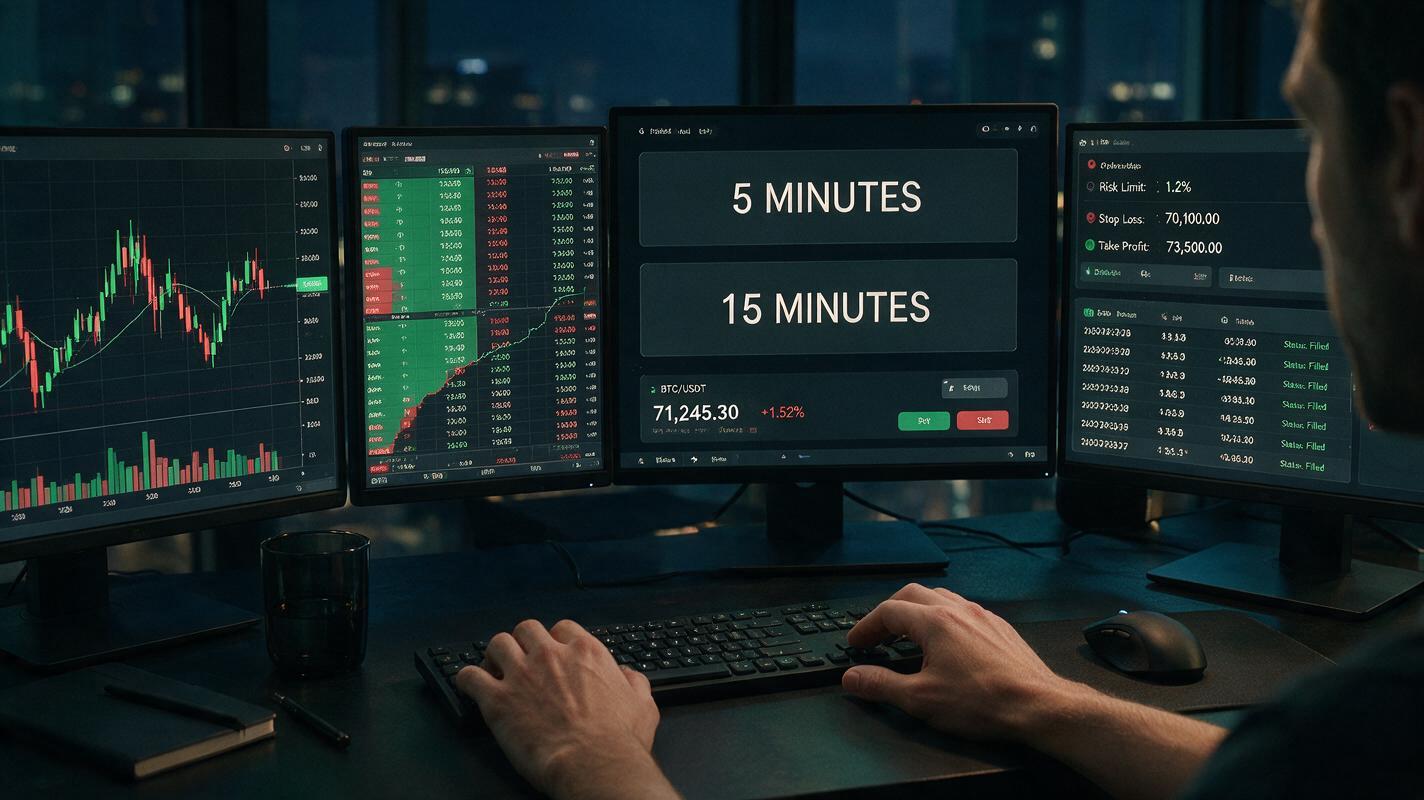
Before the strategy: the bot must calculate fair probability
A short-window bot first estimates the probability of UP and DOWN from distance to the opening reference, BTC momentum, remaining seconds, volatility, and order-book conditions. Polymarket also publishes 30-second and 60-second Chainlink-computed BTC/USD TWAP feeds. The official TWAP documentation explains the available feeds and timestamps.
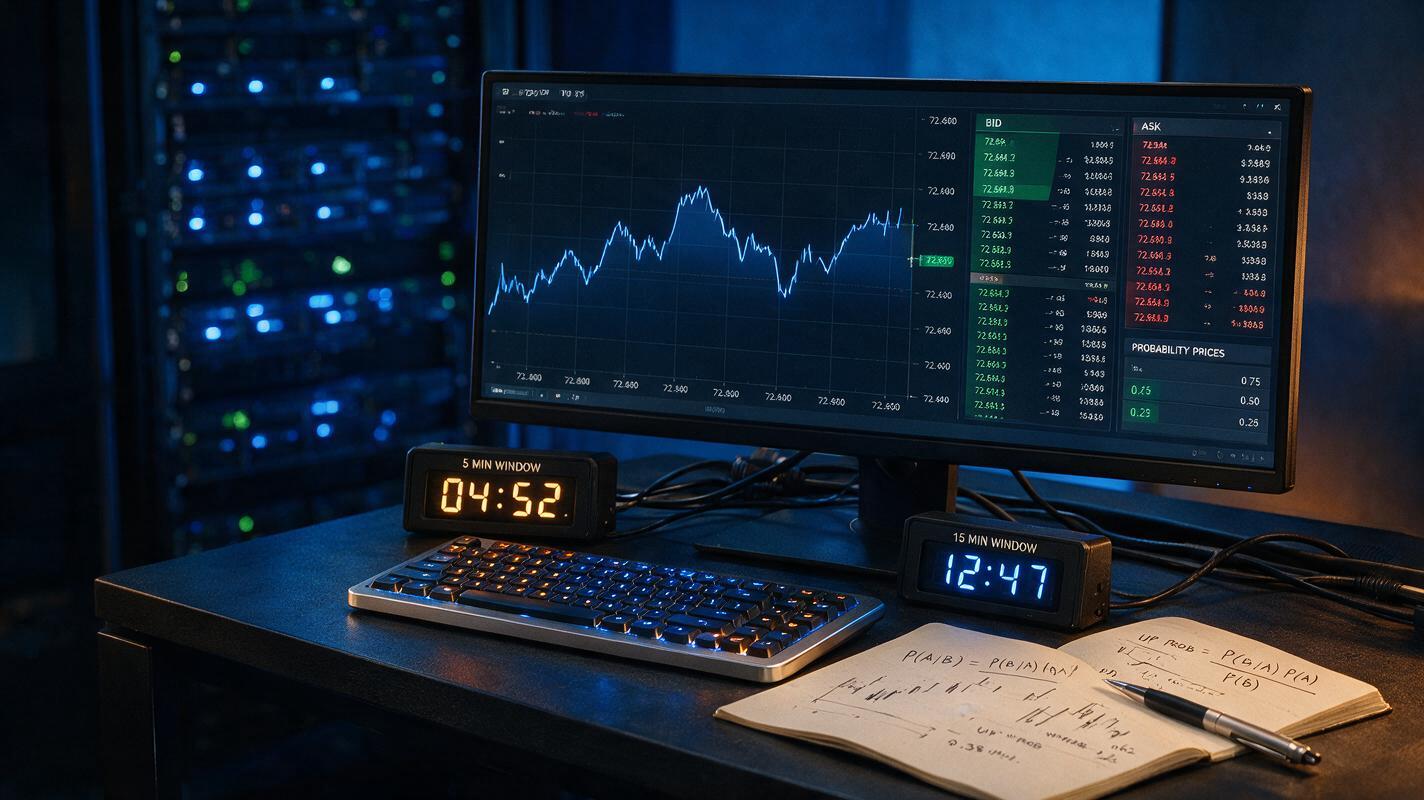
One approach updates a prior probability when new evidence arrives:
Posterior UP probability = signal likelihood under UP × prior UP probability ÷ total probability of the signal
A bot may combine several signals, but it must avoid counting the same BTC move three times as momentum, volume, and order-book pressure.
Model probability is not the final trading edge:
Net edge = model probability − depth-weighted execution price − fees − slippage − latency buffer − uncertainty
Selected crypto up-or-down markets may apply a taker delay. The official order lifecycle guide currently describes a 250 ms hold on configured markets. That delay belongs in every live and simulated result.
Strategy 1: dynamic position rotation
A dynamic rotation bot does not commit to its first directional view. It continuously recalculates fair probability and reshapes the position as evidence changes.
Suppose UP appears underpriced early in a five-minute window. The bot accumulates UP with price-limited orders. BTC then loses momentum, moves back toward the opening reference, and bid support disappears. The bot can sell part of UP, cancel resting UP orders, and begin accumulating DOWN.
How it seeks profit
The bot tries to keep more exposure on whichever outcome is currently cheaper than its updated probability estimate. It can abandon stale views faster and more consistently than a manual trader.
Main risk: whipsaw
In a noisy window, repeated switching can buy after each small rise and sell after each pullback. Fees, spread, and slippage can consume the original edge.
A rotation rule should require the new probability advantage to exceed the cost of exiting, rebuilding, and possibly being wrong again.
if new_net_edge_up > rotation_threshold:
    reduce_down_inventory()
    add_up_with_price_limit()
elif new_net_edge_down > rotation_threshold:
    reduce_up_inventory()
    add_down_with_price_limit()
Strategy 2: temporal arbitrage
Traditional binary arbitrage buys equal UP and DOWN amounts for a combined cost below $1 at the same time. Temporal arbitrage builds the two sides at different moments.
Example: after a sharp BTC rise, DOWN falls to an average purchase price of $0.28. Later BTC retraces toward the opening reference and UP becomes available at an average of $0.50. Equal quantities produce a paired cost of $0.78 before fees and other costs.
| Leg | Average price | Quantity | Paired effect |
|---|---|---|---|
| DOWN accumulated first | $0.28 | 100 | Directional until paired |
| UP accumulated later | $0.50 | 100 | Completes 100 outcome pairs |
| Total pair cost | $0.78 | 100 pairs | $0.22 gross margin before costs |
How it seeks profit
Volatility can make each side cheap at a different moment. Once paired below $1 after all costs, one outcome in each complete pair pays $1.
Main risk: the second leg never becomes cheap
The first leg is directional. If BTC continues moving one way, the bot may never complete the pair at an attractive cost. Strong implementations build small paired blocks and cap unmatched inventory, wait time, and maximum second-leg price.
Strategy 3: inventory market maker
An inventory market maker manages many small positions rather than one bet. It can quote both outcomes across consecutive five-minute and fifteen-minute windows, continuously tracking average UP cost, average DOWN cost, matched pairs, and unmatched exposure.
The current fee documentation states that makers are not charged trading fees and may receive rebates funded by taker fees. Market parameters can change, so they must be read dynamically.
How it seeks profit
- capture spread through passive orders;
- earn available maker rebates;
- sell expensive inventory before settlement;
- buy a small cheap opposite position as tail protection;
- move capital toward windows with better liquidity.
Main risk: paired inventory can still be unprofitable
If average UP cost is $0.56 and average DOWN cost is $0.49, a complete pair costs $1.05. Settlement pays only $1. The bot must earn back that five-cent deficit through spread capture, rebates, selling expensive inventory, or a controlled directional imbalance.
| Inventory metric | Why it matters |
|---|---|
| Average UP cost | Measures true cost of directional inventory |
| Average DOWN cost | Completes the paired-cost calculation |
| Paired quantity | Shows inventory with a fixed $1 combined payout |
| Unmatched quantity | Shows remaining directional risk |
| Quote age | Identifies stale orders vulnerable to informed traders |
Strategy 4: hedged directional bot
This structure sits between pure arbitrage and a fully directional position. The bot holds both outcomes but intentionally keeps a small net bias toward its preferred side.
Suppose it owns 280 UP and 257 DOWN shares. The first 257 shares on each side form a paired base. The remaining 23 UP shares create the directional exposure.
How it seeks profit
The paired base reduces the effect of being completely wrong, while the unmatched portion benefits if the model’s preferred outcome wins. The bias can expand when confidence rises and shrink when the signal weakens.
Main risk: expensive hedging
Holding both sides is not automatically safe or profitable. If the paired base costs more than $1, it locks in a negative margin. The directional excess must first recover that deficit plus all trading costs.
The bot should compare three alternatives continuously: maintain the hedge, reduce the expensive side, or hold a smaller unhedged position. Sometimes the cheapest risk control is simply less size.
Strategy 5: late-resolution capture
A late-resolution bot focuses on the closing stage. When one outcome appears nearly determined, it may still trade below $1 because sellers prefer immediate liquidity or the remaining result is not perfectly certain.
Buying at $0.986 and receiving $1 produces a gross margin of $0.014 per winning share before fees and execution costs.
How it seeks profit
The strategy repeats many small, high-probability trades where the bot believes final uncertainty is lower than the remaining discount.
Main risk: one reversal can erase many wins
A 1.4-cent gross gain is tiny compared with the potential loss if the outcome flips. The bot must model:
- distance from the opening reference;
- seconds remaining;
- current volatility and jump risk;
- the exact settlement feed and observation window;
- fees and taker delay;
- available depth at the intended size.
This strategy can show an impressive win rate while hiding severe tail risk. Evaluate expected value and worst loss, not win rate alone.
Five-strategy comparison
| Strategy | How it seeks profit | Main failure mode |
|---|---|---|
| Dynamic rotation | Keeps exposure on the currently underpriced side | Repeated whipsaw and costs |
| Temporal arbitrage | Builds a sub-$1 pair across different moments | Second leg never becomes attractive |
| Inventory market making | Spread, rebates, and inventory recycling | Adverse selection and paired cost above $1 |
| Hedged directional | Paired base plus controlled net bias | Hedge cost overwhelms directional profit |
| Late-resolution capture | Small discount on near-final outcomes | Rare reversal erases many gains |
Signals that feed these strategies
The five strategies describe position construction. Their signal engines can still use distance-to-threshold models, cross-venue BTC movement, order-book imbalance, volatility, Bayesian updates, and related-market deviations.
For example, a dynamic rotation bot may use Bayesian probability updates; a temporal arbitrage bot may use volatility and mean reversion; an inventory maker may skew quotes from order-book pressure; and a late-resolution bot may use distance, time, and tail-risk estimates.
The key separation is:
Signal layer estimates value. Strategy layer builds the position. Execution layer obtains fills. Risk layer decides whether the trade is allowed.
Production controls for BTC short windows
| Control | Purpose |
|---|---|
| Maximum data age | Stops decisions based on stale BTC or order-book updates |
| Minimum net edge | Leaves room for fees, slippage, delay, and model error |
| Maximum unmatched inventory | Limits temporal-arbitrage leg risk |
| Maximum paired cost | Prevents locking in negative combined payout |
| Rotation threshold | Reduces costly direction switching |
| Stop-new-orders time | Avoids uncontrolled entries close to resolution |
| Per-window loss cap | Prevents one noisy market from dominating the day |
| Unknown-state kill switch | Stops activity when fills or feeds cannot be verified |
Our bot architecture guide covers order states, idempotency, reconciliation, and monitoring.
How to paper-test the five strategies
Reconstruct complete position lifecycles rather than judging isolated trades. A wallet may buy UP, add DOWN later, sell part of UP, and finish with both outcomes. Looking at one transaction can misclassify the entire strategy.
Track:
- every order and cancellation;
- average cost by outcome;
- paired and unmatched quantities;
- depth-weighted execution price;
- fees, rebates, and slippage;
- seconds remaining at each action;
- reason for each rotation or hedge;
- final payout and net PnL;
- maximum drawdown and worst reversal.
A credible result includes losing periods, failed fills, skipped setups, and enough windows to cover trending, choppy, and volatile BTC conditions.
Frequently asked questions
Are these five Polymarket bot strategies guaranteed to win?
No. They are recurring strategy patterns, not guaranteed profit systems. Each has distinct execution and tail risks.
What is temporal arbitrage?
It builds opposite outcomes at different moments and attempts to create complete pairs with a combined net cost below $1.
Why would a bot hold both UP and DOWN?
It may be building paired inventory, reducing directional risk, managing market-making inventory, or keeping a controlled net bias.
Is a 98% win rate enough for late-resolution capture?
No. One reversal can erase many small wins. Compare expected value, fees, and worst-case loss.
Which strategy is safest?
None is inherently safe. Risk depends on paired cost, unmatched exposure, liquidity, model accuracy, execution, and position size.
Short-duration prediction-market and automated trading involve substantial risk of loss. Third-party performance claims are not guarantees. Review current rules, fees, and eligibility before trading.
Register on the official Polymarket website.
Affiliate disclosure: Polytrade may receive referral rewards if you register and trade through this link, at no additional cost to you.